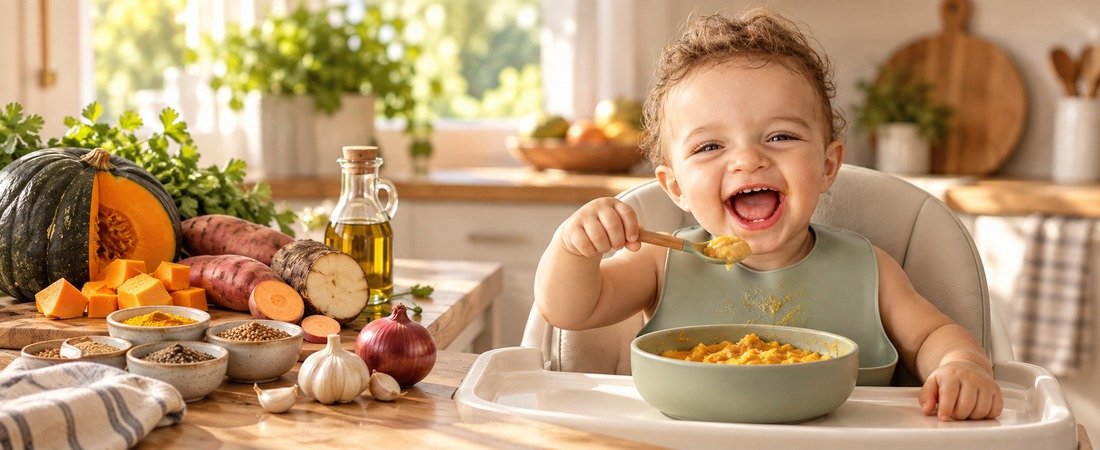
Baby congestion and noisy breathing became a constant worry for me during Henry’s first months.
I became almost obsessed with listening to him breathe.
There was mucus. A lot of it. His nose often sounded congested, and sometimes there was a whistling or wheezy quality that made me stop whatever I was doing just to listen.
As a first-time mom, my mind immediately went to bronchiolitis.
Henry was otherwise a happy, growing baby. During those episodes, I did not see his ribs pulling in when he breathed, his lips never turned blue or gray, and he did not appear to be in severe respiratory distress.
But we also never received a diagnosis explaining those sounds.
So I cannot tell you that Henry had bronchiolitis, asthma, or another respiratory condition.
I can only tell you what I observed.
And I can tell you what happened next.
Months later, when food became part of Henry’s life, I became interested in traditional approaches to food—especially Chinese food therapy and Ayurveda.
Some of the ingredients I began using were traditionally associated with concepts such as Lung, Qi, cold, and phlegm.
Then, a few weeks after this way of cooking became part of his routine, I noticed that the constant mucus and noisy breathing seemed to disappear.
Did the food cause that change? I do not know.
But the traditional ideas were part of why I chose those ingredients, and the change I noticed in Henry was real.
Those are two different statements.
This is the story of both.
Medical note: Nasal congestion can sometimes create whistling sounds, but true wheezing comes from the lower airways and should be medically evaluated. Severe difficulty breathing, blue or gray lips or face, pauses in breathing, or significant pulling in around the ribs require urgent medical care.
Baby Congestion Before Food: There Was Saline
Before Henry was eating solid food, I did not give him teas, spices, herbal mixtures, or homemade oral remedies for his breathing.
I used saline.
A lot of saline.
I used plain saline solution to help clear his nose. I did a nasal wash once, and we also did nebulizer sessions using plain saline without medication.
That is what happened in our family.
I am not presenting our nebulizer use as something another parent should copy without medical guidance.
For baby congestion, the American Academy of Pediatrics recommends plain nasal saline and gentle suction as ways to help loosen and remove mucus.
One distinction I understand much better today is that noise coming from a congested nose is not necessarily the same thing as wheezing.
The AAP notes that nasal congestion can produce whistling sounds. True wheezing is a lower-airway sound and deserves medical assessment.
At the time, however, I was simply a worried mother listening to every breath.
Then I Started Looking at Food Differently
When Henry began eating, I became more interested in what I was putting into his meals.
My interest in Chinese food therapy grew while baby congestion and his breathing were still very much on my mind.
I was reading about Ayurveda and Traditional Chinese Medicine, including Chinese food therapy.
What interested me was not the idea of rejecting conventional medicine.
It was the idea that traditional systems had spent generations describing foods according to qualities beyond calories and macronutrients.
Warm.
Cool.
Dry.
Damp.
Qi.
Lung.
Phlegm.
These are concepts from a traditional medical framework.
They are not the same thing as modern biomedical diagnoses or proof that a particular food treats respiratory disease.
The National Center for Complementary and Integrative Health explains that Traditional Chinese Medicine has a long history, but research on many traditional Chinese products and practices remains mixed or limited.
That distinction did not make me lose interest.
It helped me understand what I was actually reading.
The Little Pot I Kept Making
Once Henry was eating more substantial food, I started returning to a simple combination.
Usually the base was:
Kabocha squash + yam
or:
Kabocha squash + sweet potato.
I gently cooked garlic and red onion in a small amount of olive oil.
Then I added seasonings such as turmeric, ground coriander seed, cumin, and a tiny amount of black pepper.
The vegetables went in afterward and cooked until they were soft enough for the texture Henry could manage at that stage.
These were culinary amounts.
I was making food, not preparing a medicinal formula.
And that distinction becomes especially important when we look at why each ingredient interested me.
What Chinese Food Therapy Actually Says About These Ingredients
This is where I want to be more precise than simply saying that these ingredients are “good for mucus.”
They are not all described in the same way.
Kabocha Squash
Kabocha belongs to the winter squash group.
The Chinese food-therapy reference I consulted describes winter squash—including kabocha—as associated with channels that include the Lung and traditionally connects it with resolving phlegm.
That was exactly the type of traditional description that caught my attention.
It does not establish that eating kabocha treats congestion or wheezing in an infant.
But it explains why it became interesting to me.
Garlic
Garlic also has a strong traditional connection to the idea that initially interested me.
In the TCM food-therapy reference I consulted, garlic is associated with the Lung among other channels and is traditionally described as helping resolve phlegm and disperse cold.
In Henry’s food, however, garlic was simply part of the meal.
I was not giving concentrated garlic or using it as an herbal treatment.
Onion
Onion is similarly described in this food-therapy system as warm and pungent.
It is traditionally associated with the Lung and with concepts including moving Qi, dispersing cold, and resolving phlegm.
Again, that is a traditional classification, not evidence that onions cure respiratory symptoms.
Black Pepper
Black pepper is traditionally described as hot and pungent and is also associated with resolving phlegm.
Interestingly, the reference I consulted does not list the Lung among its main channels.
That matters because I do not want to pretend that every ingredient in my pot had the same traditional role.
I used only a tiny culinary amount.
Coriander Seed
Coriander seed is another good example of why the details matter.
The TCM food-therapy reference describes it mainly in relation to circulating Qi and dispersing cold and associates it primarily with the Stomach—not specifically with clearing Lung phlegm.
I used it because it was part of the flavor profile I liked and because the traditional framework interested me.
I would not call it a mucus treatment.
Cumin
Cumin is traditionally classified as warm and pungent and associated with the Spleen and Liver.
The reference I consulted says its specific medicinal properties in TCM are not clearly established.
So cumin stays in this story because I actually cooked with it, not because I can responsibly claim that it treats congestion.
Sweet Potato
Sweet potato is traditionally described more in terms of supporting Qi, Blood, and Yin and is associated with channels including the Spleen and Stomach.
It is not presented in the reference I consulted as a specifically Lung- or phlegm-focused food.
For Henry, it also had a very practical advantage: it became soft, slightly sweet, and easy to incorporate into his meals.
What About the Yam?
This one requires the most caution.
Chinese yam—Shan Yao—is genuinely associated with the Lung in Traditional Chinese Medicine.
Traditional materia medica describes Chinese yam in relation to nourishing Lung Yin and tonifying Lung Qi, including in traditional patterns involving chronic cough.
But Chinese yam refers to particular Dioscorea species.
I used what I knew as a true yam from the Dioscorea genus, but unless I identify the exact species, I cannot honestly say that the yam in my kitchen was Shan Yao or assign the traditional properties of Chinese yam directly to it.
That is a distinction I did not understand when I first started reading about these foods.
Now I think it is worth making.
Turmeric
Turmeric has a long history in traditional medicine, and curcumin has been studied extensively.
However, the NCCIH says there is not enough evidence to reach definitive conclusions about turmeric or curcumin for most health purposes.
So the turmeric in Henry’s food remains what it actually was:
a spice I chose intentionally and used in culinary amounts.
A Note About When Henry Started Solids
I began Henry’s complementary feeding at around four to five months.
That is what happened in our family.
Current CDC guidance recommends introducing foods other than breast milk or formula at about six months, based on developmental readiness, and does not recommend starting before four months.
I gradually changed the texture as Henry developed—from smoother foods toward mashed and more textured foods.
I did not do strict baby-led weaning.
If your baby is having difficulty with this stage, I also wrote a practical guide on what to do when a baby refuses solids.
The details of our gradual transition belong more fully in my article about feeding than in this one.
The important point here is simply this:
Food entered Henry’s life, and I began choosing ingredients more intentionally.
And Then Something Changed
After roughly three or four weeks of consistently feeding Henry this way, I realized something.
I was not hearing him anymore.
Not literally.
I was no longer hearing that constant noisy breathing.
His nose no longer seemed perpetually full of mucus.
The sound I had spent months listening for seemed to have disappeared.
His breathing sounded quiet.
For a mother who had stopped countless times just to listen to her baby breathe, that silence felt enormous.
And yes, because I had deliberately chosen some of those foods after reading about phlegm and the Lung in traditional food therapy, of course I wondered whether the two things were connected.
I still wonder.
But wondering is not proving.
What I Can Say—and What I Cannot
This is the most important distinction in this article.
I Can Honestly Say
- I became interested in Chinese food therapy while Henry was having frequent congestion and noisy breathing.
- Some of the foods I chose were traditionally associated with concepts involving Lung, phlegm, cold, or Qi.
- Those ideas influenced the way I cooked.
- After several weeks, I noticed much less mucus and quieter breathing.
- The foods stayed in our family routine afterward.
I Cannot Honestly Say
- that Henry’s food treated a respiratory disease;
- that kabocha, garlic, onion, turmeric, or yam cured his congestion;
- that Henry’s noisy breathing had one particular medical cause;
- that another baby would have the same experience;
- or that a parent should delay medical evaluation while trying foods, spices, or traditional remedies.
Both parts can be true at the same time.
My experience is real. The cause is uncertain.
And I think telling the story that way is much more useful than pretending certainty I do not have.
What I Would Watch for With Baby Congestion
If I were back in those first months, I would still listen to Henry.
But I would pay attention to more than the sound itself.
For example:
- Is the sound coming mainly from a congested nose, or does breathing seem tight?
- Is the baby breathing much faster than usual?
- Are the ribs pulling in with each breath?
- Are the lips or face changing color?
- Is the baby feeding normally?
- Does the baby seem alert and comfortable?
- Is the breathing becoming worse?
True wheezing warrants medical assessment.
Severe breathing difficulty, blue or gray lips or face, stopped breathing, or marked pulling in around the ribs are emergency signs.
That is far more important than trying to identify the right ingredient.
Food Stayed After the Mucus Left
Baby congestion eventually stopped being a central part of our daily life.
The food did not.
Henry continued eating vegetables, roots, meat, eggs, avocado, fruits, fats, and different seasonings.
What changed permanently was probably me.
I became more interested in ingredients.
I became more curious about the traditions behind food.
And I became more careful about the difference between saying:
“This food has a traditional use.”
and saying:
“This food has been proven to treat this condition.”
Those are not interchangeable statements.
I do not think we need to ridicule traditional knowledge in order to respect modern medicine.
And we do not need to turn every traditional idea into a scientific fact in order to find it interesting.
I Still Have a Medicine Cabinet. And I Still Have a Kitchen.
Motherhood changed the way I look at both.
If baby congestion or a breathing problem worries me, the kitchen is not where I would look for a diagnosis.
I would seek medical care.
But food is still one of the ways I care for my family.
Learning about the history, culture, and traditional thinking behind ingredients made me pay much closer attention to what I cook.
I cannot prove that changing Henry’s food changed his breathing.
I can tell you that I changed the way I cooked.
I can tell you what influenced those choices.
And I can tell you what I noticed afterward.
Sometimes the most honest story is the one that leaves room for:
“I don’t know.”
Have you ever discovered a food tradition after becoming a parent that changed the way you cook?
Medical disclaimer: This article describes my personal experience and discusses traditional food practices for educational purposes. Traditional Chinese Medicine terminology and historical uses are not proof that a food treats infant congestion or wheezing. A baby with suspected wheezing or breathing difficulty should be evaluated by a qualified healthcare professional.
Sources, Medical Guidance & Traditional References
Medical Guidance and Nutrition
- American Academy of Pediatrics / HealthyChildren — My Baby Has a Stuffy Nose. How Can I Help Them Sleep Safely?
https://www.healthychildren.org/English/tips-tools/ask-the-pediatrician/Pages/my-baby-has-a-stuffy-nose-how-can-i-help-them-sleep-safely.aspx - American Academy of Pediatrics / HealthyChildren — Wheezing (Other Than Asthma)
https://www.healthychildren.org/English/tips-tools/symptom-checker/Pages/symptomviewer.aspx?symptom=Wheezing%20%28Other%20Than%20Asthma%29 - CDC — When, What, and How to Introduce Solid Foods
https://www.cdc.gov/infant-toddler-nutrition/foods-and-drinks/when-what-and-how-to-introduce-solid-foods.html - CDC — Tastes and Textures
https://www.cdc.gov/infant-toddler-nutrition/foods-and-drinks/tastes-and-textures.html - NCCIH — Traditional Chinese Medicine: What You Need To Know
https://www.nccih.nih.gov/health/traditional-chinese-medicine-what-you-need-to-know - NCCIH — Turmeric
https://www.nccih.nih.gov/health/turmeric
Traditional Chinese Food Therapy References
The following references document traditional food-therapy classifications and historical uses. They do not prove that these foods clinically treat infant congestion, mucus, or wheezing.
- Chinese Nutrition — Winter Squash
https://chinesenutrition.org/view_image.asp?pid=396 - Chinese Nutrition — Garlic
https://chinesenutrition.org/view_image.asp?pid=594 - Chinese Nutrition — Onion
https://chinesenutrition.org/view_image.asp?pid=385 - Chinese Nutrition — Black Pepper
https://chinesenutrition.org/view_image.asp?pid=609 - Chinese Nutrition — Coriander Seed
https://chinesenutrition.org/view_image.asp?pid=588 - Chinese Nutrition — Cumin
https://chinesenutrition.org/view_image.asp?pid=589 - Chinese Nutrition — Sweet Potato
https://chinesenutrition.org/view_image.asp?pid=398 - American Dragon — Shan Yao / Chinese Yam
https://www.americandragon.com/Individualherbsupdate/ShanYao.html
About These References
The medical sources above support the safety and feeding guidance in this article.
The traditional references are included to explain why certain ingredients caught my attention when I was learning about Chinese food therapy.
They document traditional concepts and historical uses; they are not presented as proof that these foods treat respiratory illness in babies.
Leave a Reply