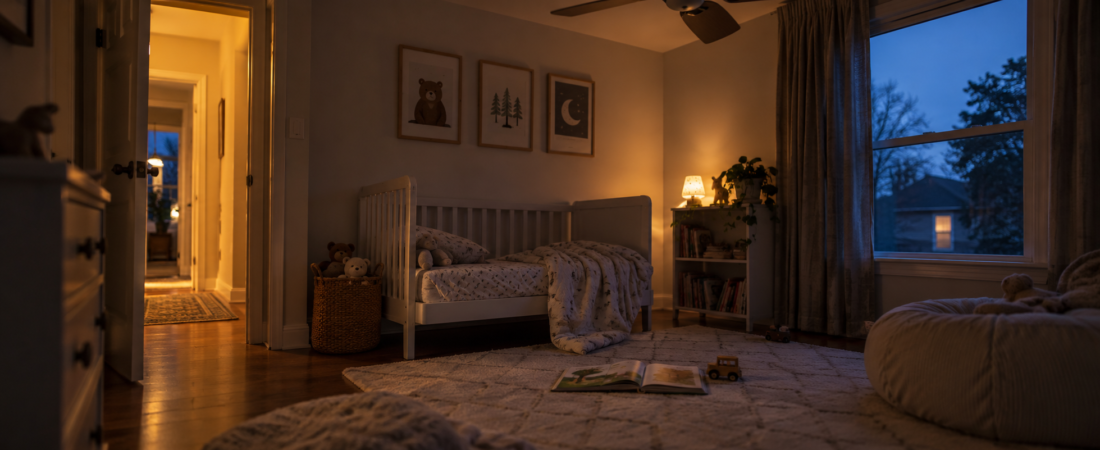
Our baby sleep routine started with me believing there had to be a secret formula for getting a baby to sleep.
A perfect bedtime.
The right number of naps.
The right routine.
Some combination that other parents had discovered and I had somehow missed.
I do not believe that anymore.
Our baby sleep routine did not make Henry sleep twelve uninterrupted hours. It did not eliminate every nighttime wake-up. And I cannot tell another mother that copying what we did will make her baby sleep the same way.
What it did give us was something much more realistic: calmer nights, familiar bedtime signals, fewer wake-ups over time, and a routine that could change as Henry changed.
Today, Henry is almost one. Most nights he falls asleep somewhere between 8:00 and 9:00 p.m., wakes around 5:30 or 6:00 a.m., and sometimes sleeps until 7:00.
He still usually wakes once during the night.
And compared with where we started, I consider that progress.
What Henry’s Nights Actually Looked Like
Our nights were never a complete disaster.
Henry did not have colic, and we were not walking through the house with a screaming baby until sunrise.
But he woke frequently during his first months.
He would wake crying, settle, sleep for a while, wake again, and repeat the cycle throughout the night.
We would go to him, comfort him, gently pat or shush him, and wait for him to settle again.
It was tiring.
Then, gradually, something changed.
Two or three wake-ups became two.
Two became one.
There was no morning when I woke up and thought, We finally solved baby sleep.
It simply became easier little by little.
That experience changed the way I understand the phrase “sleeping through the night.”
A baby who wakes sometimes is not automatically a bad sleeper. The American Academy of Pediatrics notes that nighttime waking can be normal, and babies have different sleep needs. HealthyChildren.org
For us, success stopped meaning complete silence until morning.
Success meant that the entire family was getting more rest than before.
Why Sleep Mattered So Much in Our House
Seven days after my C-section, I returned to work.
I was an independent contractor, and financially, a long maternity leave was not an option for us.
So sleep was never only a parenting topic.
I was recovering from surgery, caring for a newborn and trying to work.
I needed rest.
My husband became an essential part of our nights from the beginning.
He helped with Henry at night, and as Henry grew, bedtime also became an important part of their relationship.
For us, shared care mattered more than finding the perfect sleep course.
I wrote more about the tension between needing an income and wanting more time with my son in I Would Trade Work for More Time With My Son.
That experience also taught me something practical: a nighttime plan is not only about the baby.
It is also about the adults.
Who responds when the baby wakes?
Who desperately needs uninterrupted rest that night?
Who can take over something else in the house when the other parent is exhausted?
Those conversations did not make Henry sleep.
They made the nights easier for us to manage.
Our Baby Sleep Routine at a Glance
This is what our routine looked like when Henry was almost one.
| Part of the day | What usually happened |
|---|---|
| Morning | Henry woke early, ate and played. |
| Daytime | Normal household life continued around him: daylight, conversation and ordinary sounds. |
| Naps | He usually took a first nap and another later in the day, but their timing and length could change. |
| Around 7:30 p.m. | Bath, pajamas and a gradual transition toward a quieter evening. |
| Around 8:00–9:00 p.m. | Henry usually fell asleep, depending on how tired he was that day. |
| During the night | He usually woke once and received comfort when he needed it. |
| Morning again | Most often around 5:30–6:00 a.m.; occasionally later. |
This table is not a schedule I think another family should copy.
It is simply the clearest way I can show what our baby sleep routine actually looked like.
The most important part was not that something happened at exactly 7:32 every night.
It was that the sequence became familiar.
Consistency Helped. Rigidity Did Not.
Bath.
Pajamas.
A quieter house.
Bedtime.
Those repeated signals helped create a recognizable end to the day.
But I learned quickly that routine and rigidity are not the same thing.
Some days a nap lasted longer.
Sometimes the second nap happened later.
Sometimes Henry was sleepy earlier.
And sometimes, at bedtime, he seemed personally offended by the idea that anyone expected him to stop playing.
I stopped expecting his body to obey a schedule simply because I had written one down.
The American Academy of Pediatrics recommends simple, repeated sleep routines and calmer nighttime environments. It also recognizes that babies have different sleep needs. HealthyChildren.org
That matched our experience.
The routine gave our day some structure.
Flexibility allowed the routine to survive real life.
Daytime and Nighttime Felt Different
One thing I intentionally tried to preserve was a difference between day and night.
During the day, life continued around Henry.
There was daylight.
People talked.
A fan ran.
A truck might pass outside.
There were sounds from the workshop nearby.
At night, things became quieter and darker.
We slowed down.
I did not expect every nap to happen inside a perfectly silent room, and I did not expect normal household life to stop because Henry was sleeping.
At bedtime, however, we tried to make the environment calmer.
This is not a secret sleep technique.
It is simply one of the signals that became familiar in our home.
The AAP similarly recommends daytime interaction and play while keeping nighttime care calmer and less stimulating. HealthyChildren.org
The Safe-Sleep Part Matters More Than Any Routine
There is one part of my original experience that needs a clear distinction.
Henry sometimes napped in a hammock. He also had quiet time with his dad on our bed, and sometimes he became sleepy there.
Those things happened in our real life.
I am not presenting them as safe infant sleep recommendations.
For babies under one, the AAP’s safe-sleep guidance is more important than any routine that happened to work for one family:
- Place the baby on their back for sleep.
- Use a firm, flat, non-inclined sleep surface intended for infant sleep, such as an approved crib, bassinet or play yard.
- Use only a fitted sheet in the baby’s sleep space.
- Keep pillows, blankets, stuffed toys, bumpers and other loose objects out.
- An ordinary hammock or adult bed should not be treated as an approved infant sleep surface.
- If you are unsure whether a sleep product or setup is appropriate, check with your pediatrician and current safety guidance.
The AAP specifically states that alternative products such as hammocks are safe for infant sleep only when they comply with federal infant-sleep standards. HealthyChildren.org
That distinction matters to me because there is a difference between telling the truth about our family and telling another mother that everything we happened to do should become her routine.
The Nine-Month Finish Line I Invented
When Henry was around four months old, I was still very vulnerable to everything I saw online.
One mother said her baby started sleeping independently at nine months.
And somehow, I turned that one family’s experience into a deadline for mine.
Nine months.
I held onto that age as if something magical were supposed to happen when Henry reached it.
I thought:
Maybe that is when we will have figured this out too.
Then nine months came.
Henry was still Henry.
For a while, he had become quite good at settling himself in his crib.
Then, around ten or eleven months, things changed again.
He wanted more interaction in the evening.
He was more curious.
He wanted time with his dad after they had spent much of the day apart.
The sleep skill I thought we had permanently “achieved” changed again.
That is when I understood that sleep development was not a certificate we earned once.
It was a moving part of childhood.
I wrote more about the pressure of comparing my baby with other families online in Instagram Is Poison for First-Time Moms: What I Wish I Knew.
Dad Became Part of Bedtime
One of my favorite parts of this phase was watching bedtime become part of Henry’s relationship with his dad.
After spending the day apart, they wanted time together.
Sometimes that quiet time happened on our bed.
Sometimes a cartoon was on in the background.
That is part of the real story, but I would not describe the screen as something that helped Henry sleep. The AAP recommends turning screens off before bedtime because they can interfere with winding down and sleep. HealthyChildren.org
What mattered to me was not the television.
It was their time together.
That is the piece I would preserve.
Quiet play.
Comfort.
Connection.
A familiar person at the end of the day.
What Actually Helped Our Baby Sleep Routine
Looking back, I cannot isolate one thing and say, This caused Henry to sleep better.
He was also growing.
His sleep patterns were changing.
His needs were changing.
What I can say is that a few things made our nights more manageable: having a recognizable bedtime sequence, keeping nighttime calmer than daytime, responding to Henry instead of chasing someone else’s schedule, allowing the routine to change, and sharing the work between two parents.
That is very different from promising another family the same result.
Our baby sleep routine worked because it belonged to our family.
Another family may need something different.
Five Questions I Wish I Had Asked Instead of “Why Isn’t My Baby Sleeping Through the Night?”
Instead of comparing Henry with another baby, I eventually learned that these questions were more useful:
Is my baby safe?
Does our bedtime have a recognizable beginning?
Is this routine still appropriate for the phase my baby is in now?
Are my partner and I sharing nighttime care in a way that is sustainable?
Is something about my baby’s sleep worrying me enough that I should ask the pediatrician?
Those questions do not promise twelve hours of uninterrupted sleep.
But they are much more useful than asking why someone else’s baby sleeps differently.
When a Baby Sleep Routine Is Not Enough
A routine can organize bedtime.
It cannot diagnose a sleep problem.
If your baby’s sleep changes suddenly, if you are worried about breathing, feeding, growth or illness, or if your family is struggling to function because of sleep, talk with your pediatrician.
And if you are so exhausted that you are likely to fall asleep while holding your baby on a sofa, armchair or adult bed, safe-sleep planning becomes especially important. The AAP warns that these situations can substantially increase sleep-related risks. HealthyChildren.org
Getting help is not evidence that your routine failed.
Sometimes routine is enough.
Sometimes support is what is missing.
And sometimes there is a health or developmental question that deserves professional attention.
What Henry’s Sleep Taught Me
I used to think progress meant Henry needing us less.
Now I think progress has looked different in different phases.
Sometimes he settled himself.
Sometimes he needed comfort.
Sometimes our routine worked beautifully.
Sometimes we had to change it.
Today, he still usually wakes once.
And I still feel victorious.
Not because we discovered a secret formula.
Because the nights that once felt fragmented became manageable.
Because my husband and I learned how to share them.
Because Henry grew.
And because I eventually stopped using another baby’s sleep as the standard for our own.
A baby sleep routine can give a family structure.
It cannot guarantee a perfect night.
For us, learning that difference may have been the most useful sleep lesson of all.
What did you believe about baby sleep before becoming a parent—and what did real life teach you instead?
Personal note: This article describes our family’s experience and general educational information. It is not medical advice or an individualized sleep plan. Always follow current safe-sleep recommendations and discuss concerns about your baby’s sleep or health with a qualified healthcare professional.
Sources & Further Reading
American Academy of Pediatrics / HealthyChildren — Getting Your Baby to Sleep https://www.healthychildren.org/English/ages-stages/baby/sleep/Pages/getting-your-baby-to-sleep.aspx
American Academy of Pediatrics / HealthyChildren — How to Keep Your Sleeping Baby Safe https://www.healthychildren.org/English/ages-stages/baby/sleep/Pages/a-parents-guide-to-safe-sleep.aspx
American Academy of Pediatrics / HealthyChildren — Safe Sleep Tips for Sleep-Deprived Parents https://www.healthychildren.org/English/ages-stages/baby/sleep/Pages/safe-sleep-tips-for-sleep-deprived-parents.aspx
American Academy of Pediatrics / HealthyChildren — Healthy Sleep Habits https://www.healthychildren.org/English/healthy-living/sleep/Pages/healthy-sleep-habits-how-many-hours-does-your-child-need.aspx
Leave a Reply