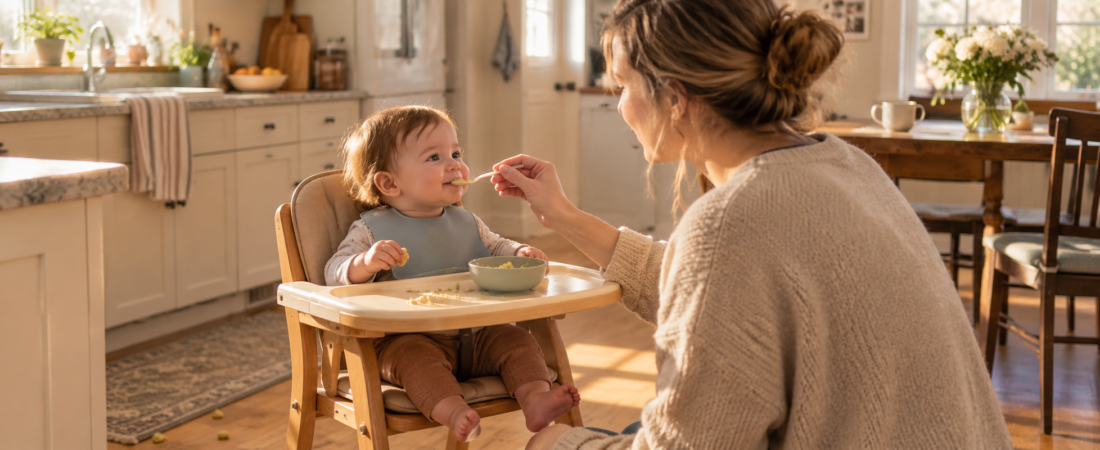
Baby-led weaning was not right for our family.
I did not start by putting pieces of food in front of Henry and letting him figure everything out from the beginning.
Instead, I chose a slower progression.
Broth and very thin purées came first in our experience. Then the food became thicker. After that, I mashed it. Later, I stopped mashing it so perfectly. There were more little lumps, more texture, and eventually pieces.
It was not a method I was trying to prove.
It was simply the way feeding felt manageable to me as a first-time mother.
For a long time, though, I felt as if I needed to explain that choice.
I don’t anymore.
Why Baby-Led Weaning Was Not Right for Us
At some point, feeding a baby became another test mothers are expected to pass.
It stopped being only:
Is my baby learning to eat?
Suddenly there seemed to be another list of questions.
Is he holding the food himself?
Did you skip purées?
Are you letting him explore?
Are you relaxed when he gags?
Does the tray look like the ones you see online?
Apparently, a bowl and a spoon can make a mother feel old-fashioned now.
I did not enjoy that pressure.
I know many families genuinely love baby-led weaning, and I am not saying they are wrong.
It simply was not how I wanted to begin with Henry.
I was nervous.
I wanted to see what he was eating. I wanted to control how soft the food was. I wanted to make it a little thicker when I felt he was managing the current texture well.
Most importantly, I wanted feeding to feel calm in my own body too.
That mattered.
What Our Gradual Feeding Progression Looked Like
There was no morning when I suddenly decided:
Today Henry graduates to the next texture.
It happened gradually.
This is the easiest way I can describe our progression:
| Stage in our experience | What changed |
|---|---|
| Very smooth | Broth and thin purées were part of our earliest experience with food. |
| Thicker purées | I gradually used less liquid and allowed the food to have more body. |
| Mashed food | Instead of blending everything completely smooth, I started mashing it. |
| More texture | I stopped trying to remove every little lump. |
| Soft pieces | As Henry became more capable, pieces gradually became part of his meals. |
| More independence | Utensils, fingers, pieces, and family foods became increasingly normal. |
This is not a schedule another baby needs to follow.
I am not saying a baby should spend a certain number of days or weeks at each stage.
I am simply showing what “gradual” meant in our home.
The important part was that I kept moving forward.
I was not trying to keep Henry on purées forever.
Gradual Feeding Is Not the Same as Staying on Purées
This distinction matters.
When I say I did not do baby-led weaning, I do not mean I avoided texture.
Actually, texture was a major part of the process.
I just introduced it progressively.
When one consistency became familiar, I made the food a little less smooth.
Later, I mashed rather than blended.
Then I left more texture.
Eventually there were pieces.
That progression is also compatible with current CDC guidance, which describes smooth puréed foods, mashed or lumpy foods, and finely chopped or ground foods as different textures children can experience as their eating abilities develop.
The CDC also encourages giving children opportunities to pick up appropriate foods with their fingers as they develop those skills.
So this was never:
spoon forever versus independence.
For us, it was:
spoon first, changing textures, then increasing independence along the way.
What I Paid Attention to Before Changing the Texture
I did not have a complicated chart.
Mostly, I watched Henry eat.
I noticed whether the current texture seemed easy for him to manage.
I noticed how he moved food around his mouth.
I noticed whether he was becoming comfortable with something that had previously felt unfamiliar.
And then, instead of keeping everything exactly the same, I changed it slightly.
A little thicker.
A little less perfectly mashed.
A softer piece.
Another opportunity to hold food himself.
The goal was never to remove every challenge.
The goal was to avoid making one enormous jump just because I thought I was supposed to.
Current feeding guidance also emphasizes matching food texture, size, and preparation to a child’s developmental eating skills.
That idea makes much more sense to me than treating every baby as if the same feeding format must work on the same day.
Using a Spoon Did Not Mean I Was Preventing Independence
This was one of the things I worried about unnecessarily.
Online, spoon-feeding and independence are sometimes presented as opposites.
They do not have to be.
The American Academy of Pediatrics says families can adapt the baby-led approach to fit their situation and specifically notes that spoon-feeding a baby for days or weeks does not mean the child will fail to learn independent eating.
The CDC similarly describes spoon-feeding puréed or mashed foods as part of early learning while also encouraging children to gradually practice fingers, spoons, forks, and cups as their skills develop.
That is much closer to what happened naturally in our house.
I helped Henry.
Then he did more.
Then I helped less.
It was not one dramatic transfer of responsibility.
It was learning.
There Was No Perfect Method at Our Table
This part matters even more to me now.
Some meals Henry accepts utensils.
Other times, he wants me to help.
Sometimes he eats something happily and then rejects the exact same food another day.
Sometimes food ends up on the floor.
Sometimes I prepare something I am almost certain he will eat—and I am completely wrong.
Feeding is still one of the parts of motherhood that can frustrate me.
I do not want to rewrite that reality into one of those beautiful stories where gradual feeding created a child who now happily eats everything.
It didn’t.
He is still a child.
He still has preferences.
He still refuses food.
He still surprises me.
And when refusal itself becomes the issue, that is different from deciding whether to use BLW or purées. I wrote separately about what I do when a baby refuses solids, because I think that deserves its own conversation rather than being squeezed into this one.
Gradual Does Not Mean Behind
This is probably what I wish I had understood most clearly at the beginning.
Gradual does not automatically mean delayed.
Using a spoon does not automatically mean preventing independence.
Starting with smooth food does not mean you have to stay there.
Offering purées does not mean a child will never learn to chew.
And offering pieces does not automatically make another family more advanced.
Babies need opportunities to experience different tastes and textures because those experiences help develop eating and chewing skills.
The part that matters is continuing to develop those opportunities safely—not belonging to the correct online feeding camp.
The Internet Made This Feel More Complicated Than It Needed to Be
I have written before about the pressure social media can create for first-time mothers.
Feeding was another version of it.
A beautiful high chair.
Perfectly cut food.
A baby holding everything independently.
A parent who apparently never looks nervous.
It can be useful content.
It can also make an ordinary mother with a bowl and spoon wonder whether she is somehow doing motherhood incorrectly.
I already wrote about that broader pressure in my article about Instagram and first-time motherhood.
With feeding, though, I eventually realized something simple:
I was not feeding the internet.
I was feeding Henry.
And Henry was the person I needed to watch.
What the Perfect Feeding Video Does Not Show
There may be ten attempts behind one successful video.
Food refused.
Food spat out.
Food thrown.
A baby who was tired.
A parent who was frustrated.
Then, eventually, one meal where everything worked.
That is the clip everyone sees.
I know because I live the unedited version.
Sometimes I sweep up more food than Henry actually swallowed.
Sometimes he wants help even though I know he is capable of doing more himself.
Sometimes the meal I prepared gets cold while I try to understand whether he is finished, distracted, uncomfortable, or simply uninterested.
There is nothing wrong with sharing the beautiful moments.
The problem begins when we start treating someone else’s beautiful moment as evidence that our own ordinary one is failure.
A Simple Way I Think About Texture Progression Now
If I had to explain my approach to another mother in a few questions, I would not ask:
Am I doing BLW correctly?
I would ask:
- Is my child getting opportunities to experience different textures?
- Am I allowing the texture to develop rather than keeping everything completely smooth?
- Is the food prepared appropriately for my child’s current eating skills?
- Is my child getting opportunities to touch, hold, and eventually self-feed?
- Am I watching my child rather than following someone else’s timeline?
- Am I keeping the meal calm instead of forcing food?
- Do I know the basic choking hazards and how to prepare foods more safely?
That is a much more useful checklist to me than asking whether I belong to one feeding method.
A Quick Note About Gagging, Choking, and Safe Preparation
Texture progression does not mean giving a baby any food in any form.
Food still needs to be prepared for the child’s developmental stage.
The CDC recommends preparing foods in the appropriate shape, size, and texture, keeping children seated upright while eating, supervising them closely, and avoiding foods and shapes that are common choking hazards.
Gagging can happen while babies learn to handle new textures, but choking is different and can be dangerous.
If you have concerns about readiness for solids, chewing, swallowing, growth, or repeated difficulty managing textures, that is a conversation for your child’s pediatrician or another qualified healthcare professional.
This article is my experience—not a substitute for individual feeding guidance.
The Point Was Never the Spoon
That is probably the sentence I would keep from everything I learned:
The spoon was never the point.
The point was progression.
The point was paying attention.
The point was helping Henry learn without feeling that I had to turn feeding into a test of whether I was confident enough, modern enough, or relaxed enough.
Over time, there were more textures.
More pieces.
More fingers in the food.
More attempts with utensils.
More independence.
It happened.
Just not all at once.
I Stopped Apologizing for Not Doing Baby-Led Weaning
I did not do baby-led weaning in the strict way I kept seeing online.
I used a bowl.
I used a spoon.
I made thin food.
Then thicker food.
Then mashed food.
Then food with more texture.
Then pieces.
And Henry learned.
That is what I wish I had trusted sooner.
There did not need to be one dramatic moment when I proved I was brave enough to let him eat.
There only needed to be a next step.
And then another one.
And another.
That is how our feeding story happened.
Not perfectly.
Not according to one method.
Just gradually.
Did you follow one feeding method, combine different approaches, or find your own way as you went?
This article shares my personal experience and general feeding information. It is not medical advice or an individualized feeding plan. Talk with your child’s pediatrician or another qualified healthcare professional if you have concerns about readiness for solids, feeding development, choking, chewing, swallowing, allergies, or growth.
Sources & Further Reading
CDC — Tastes and Textures
The CDC describes smooth, puréed, mashed or lumpy, and finely chopped or ground textures and explains that textures can progress as eating skills develop. CDC — Tastes and Textures
CDC — When, What, and How to Introduce Solid Foods
Guidance on introducing solids, changing food texture as skills develop, and preparing foods safely. CDC — Introducing Solid Foods
CDC — Choking Hazards
Guidance on food size, shape, texture, positioning, supervision, and common choking hazards. CDC — Choking Hazards
CDC — Fingers, Spoons, Forks, and Cups
Information about how self-feeding skills develop alongside spoon-feeding and other eating skills. CDC — Fingers, Spoons, Forks, and Cups
American Academy of Pediatrics / HealthyChildren — Baby-Led Weaning: Is It Safe?
AAP overview of BLW, its possible benefits and risks, safety considerations, and ways families can adapt the approach. AAP / HealthyChildren — Baby-Led Weaning
Leave a Reply